

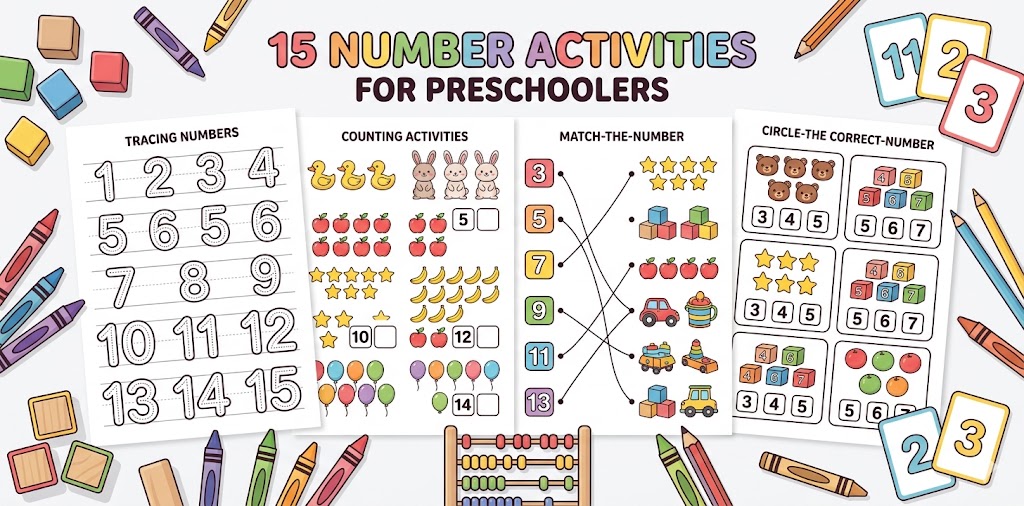
15 Best Number Activities for Preschoolers: Complete Guide to Early Math Learning
Teaching numbers to preschoolers (ages 3-5) is one of the most important foundational skills. However, direct instruction doesn’t work. Preschoolers learn through play, exploration, and hands-on activities.
This comprehensive guide provides 15 proven number activities that will help your child master counting from 1-10, recognize numbers, and develop number sense naturally.
1. Number Tracing Worksheets (Learn to Write Numbers)
What It Is:
Children trace dotted numbers to develop fine motor skills and number recognition simultaneously.
How to Do It:
- Download or create printable worksheets
- Provide large dotted numbers (start with 1-5)
- Give your child a pencil (thick pencils are better)
- Child traces dots to form the number
- Repeat 5-10 times per number
- Gradually reduce dot size
Benefits:
- Develops pencil grip and hand strength
- Improves number recognition
- Enhances hand-eye coordination
- Builds muscle memory for writing
- Increases concentration span
Materials Needed:
- Printable worksheets
- Pencils (HB or 2HB)
- Colored pencils or crayons
- Paper
Pro Tips:
- Start with number 1 (easiest to trace)
- Let them use thick markers for better control
- Celebrate small achievements
- 5-10 minutes per session is enough
- Don’t force if they’re not interested
Where to Find Worksheets:
- myworksheetlab.com (Your site!)
- teacherspayteachers.com
- pinterest.com (search: free number tracing)
- education.com
- super-duper.com
2. Counting Objects Activity (Concrete Learning)
What It Is:
Children count real, tangible objects – this is the foundation of number sense.
How to Do It:
Choose objects:
- Building blocks / Lego bricks
- Beads or buttons
- Toys (cars, dolls)
- Pasta pieces
- Snacks (crackers, cheerios)
- Coins or counters
Activity Steps:
- Place 3-4 objects on a table
- Ask: “How many do we have?”
- Point to each object while counting
- Child repeats after you
- Gradually increase to 5, then 10 objects
Difficulty Levels:
- Level 1 (Age 3): 1-3 objects
- Level 2 (Age 4): 1-5 objects
- Level 3 (Age 5): 1-10 objects
Learning Outcomes:
- Understanding “one-to-one correspondence”
- Learning to count in sequence
- Developing number sense
- Understanding “more” and “less”
- Concrete to abstract thinking transition
Make It Fun:
- Use favorite toys or foods
- Make silly counting (hop while counting)
- Count in different languages
- Race: “Who can count faster?”
3. Number Songs and Rhymes (Music-Based Learning)
Why Songs Work:
Music helps children retain information better. Numbers set to familiar tunes are easier to remember.
Popular Preschool Counting Songs:
- “One, Two, Buckle My Shoe”
- “Five Little Ducks Went Out to Play”
- “Ten Little Numbers Dance Along”
- “The Numbers Song” (Super Simple Songs)
- “Count to 10 Song”
- “Five Little Monkeys Jumping on the Bed”
Best YouTube Channels:
- Super Simple Songs (BEST for preschool)
- CoComelon (Excellent animations)
- Kids Learning Tube
- The Kiboomers
- StepbyStepSongs
How to Use Songs in Learning:
| Day 1: | Listen to the song (2-3 times) |
| Day 2: | Sing together with the video |
| Day 3: | Add hand motions and finger counting |
| Day 4: | Sing without video |
| Day 5: | Dance while singing |
Extend Learning:
- Make up your own hand motions
- Use props (stuffed animals, toys)
- Slow down the tempo
- Sing in different voices (high, low, silly)
Benefits:
- Improves auditory memory
- Makes learning fun and engaging
- Better number retention
- Develops language skills
- Creates positive learning associations
4. Number Matching Game (Visual Discrimination)
What It Is:
Children match numbers with corresponding quantities (dots, pictures, objects).
DIY Activity:
Materials Needed:
- Cardstock or cardboard
- Markers or printed numbers
- Stickers or clip art images
- Scissors
Steps to Create:
- Divide paper into two columns
- Write numbers 1-10 in left column
- Draw or paste dots/images in right column
- Example: “3” with 3 apples, “5” with 5 stars
- Laminate for durability
- Child matches left column to right
Alternative: Use clothespins or pegs to mark matches
Printable Options:
- myworksheetlab.com
- Pinterest (search: number matching worksheets)
- teacherspayteachers.com
- mathsisfun.com/kids
Advanced Variations:
- Level 1: 1-3 numbers
- Level 2: 1-5 numbers
- Level 3: 1-10 numbers
- Challenge: Match to dot patterns (not just quantity)
5. Number Flashcard Activity (Quick Recognition)
How to Make Flashcards:
Materials:
- Index cards (3×5 inches)
- Thick markers
- Stickers or pictures
- Punch and ring (optional)
Creation Steps:
- Write large number on one side (2-3 inches tall)
- Draw matching dots below the number
- On back: paste pictures or stickers (5 dots = 5 objects)
- Laminate for durability
- Optional: bind with ring for easy storage
Variation: Create bilingual flashcards (English + Spanish)
How to Use Flashcards:
Daily Practice (10 minutes):
- Show card for 2-3 seconds
- Ask: “What number is this?”
- Repeat 5 times before moving to next number
- Praise correct answers
- Don’t punish wrong answers – just correct gently
Progressive Learning:
- Week 1: Numbers 1-3
- Week 2: Numbers 1-5
- Week 3: Numbers 1-8
- Week 4: Numbers 1-10
Pro Tips:
- Hold cards at child’s eye level
- Mix cards randomly
- Start slow – quality over speed
- Keep sessions short (5-10 minutes)
- Play: “Guess which number I’m thinking of”
- Use as memory game: flip and match pairs
6. Number Line Activity (Understanding Sequence)
What It Is:
Understanding that numbers follow a specific sequence and have relationships (what comes before/after).
DIY Number Line:
Materials:
- String, tape, or painted line
- Index cards with numbers
- Markers
- Space (floor or wall)
Creation:
- Make 10 squares in a line (tape on floor)
- Write numbers 1-10 (one per square)
- Place numbers randomly out of order
- Child arranges them in correct sequence
- Child hops along the line while counting
Activities on Number Line:
- Sequencing: Put numbers in order (1-10)
- Missing Number: 1, 2, __, 4, 5
- Backward Counting: 10, 9, 8, 7…
- Skip Counting: 2, 4, 6, 8, 10
- Jumps: “Jump to number 5”
Advanced Activities:
Addition intro:
Start at 2, jump 3 times: 2→3→4→5 (Introduction to 2+3=5)
Backward/Subtraction:
Start at 5, jump back 2: 5→4→3 (Introduction to 5-2=3)
7. Sensory Number Activities (Multi-Sensory Learning)
A. Sand Tray Numbers:
Materials:
- Shallow tray or large baking pan
- Kinetic sand or play sand
- Finger or stick
Activity:
- Fill tray with 2-3 inches of sand
- Smooth the surface
- Child traces number with finger
- Create the number shape
- Smooth and repeat
Benefits:
- Tactile learning
- Fine motor skill development
- Engaging and fun
- Can erase and repeat endlessly
B. Playdough Numbers:
Materials:
- Playdough (store-bought or homemade)
- Multiple colors
- Sticks for details
Homemade Playdough Recipe:
- 2 cups flour
- 1 cup salt
- Water (add gradually)
- Food coloring
- 2 tbsp oil
Activity:
- Roll playdough into “snakes”
- Shape into numbers
- Use different colors for each number
- Stick with numbers written on paper below
- Press and remake
C. Textured Numbers:
Materials:
- Heavy paper or cardboard
- Feathers, cotton, sandpaper, yarn
- Glue
Activity:
- Print large number outlines
- Child glues materials inside the outline
- Run fingers over the number (feel the texture)
- Close eyes and trace (develop tactile recognition)
Benefits:
- Multiple sensory input
- Develops number shape memory
- Engages different learning styles
8. Number Hopscotch Game (Physical Activity)
How to Set Up:
Materials:
- Chalk (for outdoor)
- Tape (for indoor)
- Stone or bean bag
Setup Steps:
- Draw 10 squares in a line
- Write numbers 1-10 in squares
- Alternate single and double squares
- Stand behind first square
How to Play:
Round 1: Toss stone on #1
- Hop to #1 (skip #1)
- Continue hopping to #10
- Hop back
- Pick up stone
- Repeat for each number
Variations:
- Two feet vs one foot
- Backward hopping
- Different speeds (slow, fast, giant hops)
- Skip counting (2, 4, 6, 8…)
- Count out loud while hopping
Benefits:
- Physical exercise
- Number recognition
- Gross motor development
- Balance and coordination
- Outdoor fun
9. Number Sorting Activity (Organization Skills)
What It Is:
Organizing objects according to numbers – early categorization skill.
DIY Activity:
Materials:
- Small objects (buttons, beads, blocks)
- Containers (cups, boxes, bowls)
- Number labels (1-5)
Setup:
- Label each container with a number (1-5)
- Place all objects in a pile
- Child counts and sorts objects into containers
- Container labeled “3” gets 3 objects, etc.
Examples:
- Container 1: 1 red button
- Container 2: 2 blue beads
- Container 3: 3 wooden blocks
- Container 4: 4 pasta pieces
- Container 5: 5 coins
Progression:
- Week 1: Numbers 1-3
- Week 2: Numbers 1-5
- Week 3: Numbers 1-8
- Week 4: Numbers 1-10
Benefits:
- Counting practice
- One-to-one correspondence
- Fine motor skills
- Organization and categorization
- Problem-solving
10. Number Puzzle Activity (Problem Solving)
Type 1: Sequence Puzzles
Activity:
- 1, 2, __, 4, 5
- 3, __, 5, 6, 7
Child fills missing numbers
Variations:
- Backward: 5, 4, __, 2, 1
- Skip counting: 2, 4, __, 8, 10
- Mixed: 1, __, 3, 4, __
Type 2: Jigsaw Number Puzzles
Materials:
- Thick cardboard or foam board
- Numbers drawn/printed
- Scissors
Activity:
- Draw large number on board
- Cut into 3-5 puzzle pieces
- Child reassembles the number
- Can do with multiple numbers simultaneously
Type 3: Dot-to-Dot Numbers
Materials:
- Numbered dots (1-10 sequence)
- Pencil or marker
Activity:
- Connect dots in number order
- Picture emerges
- Teaches sequence and number order
Resources:
- myworksheetlab.com
- Pinterest (search: dot to dot numbers)
11. Digital Number Games (Apps & Websites)
Best Educational Apps:
| App Name | Cost | Features | Rating |
|---|---|---|---|
| Khan Academy Kids | FREE | Number recognition, Counting practice, Personalized learning | ⭐⭐⭐⭐⭐ |
| 1-10 Numbers for Kids | FREE | Simple number tracing, Counting games, Voice guidance | ⭐⭐⭐⭐ |
| Preschool Learning Games | FREE/Premium | Multiple number activities, Progress tracking, Colorful graphics | ⭐⭐⭐⭐ |
| Math Bingo | FREE | Interactive bingo game, Number recognition, For 2+ players | ⭐⭐⭐⭐ |
| Teach Me Numbers | $2.99 | High-quality content, Multiple languages, Excellent reviews | ⭐⭐⭐⭐⭐ |
| Duolingo Kids | FREE | Includes numbers section, Fun and engaging, Motivating system | ⭐⭐⭐⭐ |
Best Websites:
- kidsacademy.mobi (FREE/Premium)
- mathsisfun.com/kids (FREE)
- khan.org/kids (FREE)
- coolmathgames.com (Ages 5+, FREE)
Screen Time Guidelines:
- Maximum: 15-20 minutes per day
- Best time: Mid-morning or early afternoon
- Avoid: Not before bedtime
- Balance: 80% offline, 20% online activities
How to Use Digital Resources Effectively:
- Play together first time
- Child learns game mechanics
- Then child plays independently
- Check progress weekly
- Praise effort, not just results
12. Number Bingo Game (Social & Fun)
How to Create Bingo Cards:
Materials:
- Cardstock (5×5 grid = 25 squares)
- Markers
- Colored paper
Card Setup:
- Randomly arrange numbers 1-10
- Include FREE space in center
- Make 3-4 different cards
How to Play:
Players: 2-4 children + adult caller
Setup:
- Each player gets a bingo card
- Adult calls numbers randomly
- Players mark called numbers
- First to get 5 in a row (horizontal, vertical, diagonal) wins!
Calling Example:
- “Number 5!”
- “Number 2!”
- “Number 8!”
- “Number FREE!”
Rewards:
- Small prizes (stickers, erasers, pencils)
- Certificate of achievement
- Praise and celebration
- Special snack for winner
Benefits:
- Number recognition
- Social skills
- Attention and focus
- Patience
- Learning through play
- Group interaction
13. Bead Strings / Counting Strings (Hands-On Tool)
DIY Bead String:
Materials:
- String, yarn, or cord (12-18 inches)
- 10 beads (wooden or plastic)
- Tape (to prevent fraying)
Creation Steps:
- Cut string to appropriate length
- Tape one end (makes threading easier)
- Thread beads onto string
- Tie secure knot at end
- Bead string ready to use!
Alternative:
- Use commercial bead strings (cheap online)
- Pony beads + string from craft stores
How to Use:
Activity 1: Basic Counting
- Point to each bead while counting
- Count forward: 1-10
- Count backward: 10-1
- Repeat daily
Activity 2: Number Recognition
- “Touch bead #5”
- “Which bead is #3?”
- Child points to correct bead
Activity 3: Pattern Making
- Use different colored beads
- Create patterns: Red-Blue-Red-Blue
- Extend pattern
- Name patterns
Activity 4: Skip Counting
- Count beads 1, 2, 3, 4, 5
- Then count: 2, 4, 6, 8, 10
- Understand even numbers
Benefits:
- Concrete counting tool
- Fine motor practice
- Portability
- Durability (reusable)
- Tactile learning
- Multiple learning objectives
14. Number Storytelling (Narrative Learning)
Popular Number Stories for Preschool:
| Story Title | Numbers | Learning Focus |
|---|---|---|
| Three Little Pigs | 3 (main character) | Counting to 3, sequence |
| Five Little Monkeys Jumping on the Bed | 5, 4, 3, 2, 1 (countdown) | Backward counting, subtraction intro |
| Two Little Ducks | 2 (main characters) | The number 2 |
| Seven Silly Stars | 7 | The number 7 |
| Ten Green Bottles Hanging on the Wall | 10, 9, 8… (countdown) | Subtraction concept |
How to Use Stories:
Step 1: Read/Tell the story
- Use expressive voice
- Show pictures or illustrations
- Use props (toys, puppets)
Step 2: Highlight Numbers
- Emphasize number words
- Count items in story
- Act out with fingers
Step 3: Interactive Elements
- Ask questions: “How many pigs?”
- Let child answer
- Celebrate correct answers
Step 4: Extend Learning
- Draw characters
- Act out story
- Count props
- Create your own story
Step 5: Repetition
- Tell same story multiple times
- Child learns numbers through context
- Build familiarity
Create Custom Stories:
Example: “Sarah’s Birthday”
“Sarah is turning 3 years old. She has 3 friends coming to her party. They each bring 1 gift. How many gifts? [3] They eat 2 cupcakes each. How many cupcakes? [6]”
Benefits:
- Numbers in context
- Real-life application
- Personalized learning
- Emotional connection
15. Number Writing Practice Sheets (Structured Learning)
Types of Practice Worksheets:
- Type 1: Number Tracing – Dotted numbers to trace repeatedly
- Type 2: Dot-to-Dot – Connect numbered dots to form picture
- Type 3: Counting Objects – Count objects and write number
- Type 4: Missing Numbers – Fill in missing numbers in sequence
- Type 5: Number Sequencing – Arrange numbers 1-10 in order
- Type 6: Number Matching – Match numbers to quantities
- Type 7: Before & After – Write numbers before and after
- Type 8: Number Copying – Copy numbers shown at top
Where to Find Quality Worksheets:
- myworksheetlab.com (Your site!) – Specifically designed for preschool
- teacherspayteachers.com – Teacher-created, highly rated
- Pinterest.com – Free printables, huge variety
- education.com – Professional worksheets
- kidsacademy.mobi – Interactive worksheets
Age-Based Progress Guide:
Age 3 (Toddler Preschool):
| ✅ Recognize numbers 1-3 |
| ✅ Count objects (1-3) |
| ✅ Learn number songs |
| ✅ Understand “one,” “two,” “many” |
| ✅ Paint/color number pictures |
| ✅ Match quantities (2 apples with 2 cups) |
Activities to Focus On:
- Songs and rhymes
- Counting objects
- Sensory activities
- Matching games
- Picture books about numbers
Time: 10 minutes, 3x per week
Age 4 (Older Preschool):
| ✅ Recognize numbers 1-5 |
| ✅ Write numbers 1-5 (with help) |
| ✅ Count objects 1-5 |
| ✅ Understand more/less |
| ✅ Simple number matching |
| ✅ Introduction to number line |
Activities to Focus On:
- Number tracing
- Counting games
- Flashcards
- Sorting activities
- Puzzle activities
Time: 15 minutes, 4x per week
Age 5 (Pre-K/Kindergarten Prep):
| ✅ Recognize and write numbers 1-10 |
| ✅ Count accurately to 10+ |
| ✅ Understand number sequences |
| ✅ Add using objects (1+2=3) |
| ✅ Subtract using objects (5-2=3) |
| ✅ Number line understanding |
Activities to Focus On:
- Number writing practice
- Addition with objects
- Skip counting
- Backward counting
- Number line activities
Time: 20 minutes, 5x per week
Progress Tracking System:
Create a Progress Chart:
📊 Simple Checklist:

NUMBER 1: ☐ Recognize ☐ Say ☐ Write ☐ Count to 1
NUMBER 2: ☐ Recognize ☐ Say ☐ Write ☐ Count to 2
NUMBER 3: ☐ Recognize ☐ Say ☐ Write ☐ Count to 3
NUMBER 4: ☐ Recognize ☐ Say ☐ Write ☐ Count to 4
NUMBER 5: ☐ Recognize ☐ Say ☐ Write ☐ Count to 5

[Continue for 6-10...]

Check off as child masters each skill
Weekly Progress Notes:
- Week 1: Child learned to count to 3, Recognizes number “1”, Enjoys counting songs
- Week 2: Can trace number 1, Learning number 2, Prefers physical activities
- Week 3: Knows 1-3, Writing is improving, Ready for number 4
Photo Documentation:
- Take photos/videos of child doing number activities
- First time writing numbers
- Playing games
- Progress milestones
- Create portfolio showing growth over time
Parents’ Tips for Success:
1. Consistency is Key:
- Set regular time daily (same time is best)
- Morning activities are often better
- 10-20 minutes is optimal
- Consistency beats intensity
Example Schedule: Monday-Friday: 15 minutes after breakfast, Numbers activity + song + practice
2. Make It Play, Not Work:
- Remove pressure
- Let child lead sometimes
- Change activities frequently
- Keep it light and fun
- Stop before child gets bored
- Celebrate small wins
Don’t:
- Force learning
- Compare to other children
- Show frustration
- Make it stressful
- Keep going if child is tired
3. Use Real-Life Examples:
Grocery shopping: “Let’s count the apples: 1, 2, 3, 4, 5”
Snack time: “You have 2 cookies. I have 3. Who has more?”
Playing with toys: “We have 5 cars. How many cars?”
Getting dressed: “Count your buttons: 1, 2, 3, 4”
Bedtime: “We read 2 stories. How many more until you sleep?”
Benefits:
- Numbers in context
- Real-world relevance
- Informal learning
- Child sees numbers matter
4. Balance Digital and Physical:
| Activity Type | Percentage | Duration |
|---|---|---|
| Physical Activities (games, hands-on) | 80% | 60-80 min |
| Screen Time (apps, videos) | 20% | 15-20 min |
5. Positive Reinforcement:
DO THIS:
- “Great job counting to 5!”
- “I saw you trying hard to write the number 3!”
- “You counted 3 objects correctly!”
- “I’m so proud of your effort!”
AVOID THIS:
- “You got it wrong”
- “That’s not right”
- “Why can’t you do this?”
- “You’re not trying hard enough”
6. Individual Learning Pace:
- Every child is different
- Some learn numbers in weeks
- Others need months
- This is NORMAL
- Don’t compare with other children
Signs Child Needs Slowing Down:
- Frustration or tears
- Resistance to activities
- Consistently getting wrong answers
- Loss of interest
Signs Child is Ready for Challenge:
- Quick mastery
- Asking for more
- Seeming bored
- Wanting harder games
Common Mistakes to Avoid:
| Mistake | Problem | Solution |
|---|---|---|
| Too Much, Too Fast | Teaching 1-10 all at once | Master 1-3, then add 4-5 |
| Forcing Learning | Continuing when child is frustrated | Stop, try again later |
| Using Numbers in Punishment | Counting how many minutes in time-out | Keep numbers positive |
| Only Screen-Based Learning | All learning through apps | 80% hands-on, 20% digital |
| Expecting Same Pace as Siblings | Comparing to older/younger sibling | Celebrate individual progress |
| No Variety | Doing same activity daily | Mix different activities |
| Neglecting Enjoyment | Focus only on learning | Make it FUN first, learning second |
Free Resources Directory:
Websites (Mostly FREE):
- myworksheetlab.com – Preschool worksheets, Numbers, colors, shapes
- mathsisfun.com/kids – Interactive math games, Age-appropriate
- kidsacademy.mobi – Large library, Some free content
- supercoloring.com – Number coloring pages, Free PDF download
- sparklebox.co.uk – Teacher-created resources, High quality
- education.com – Huge worksheet library, Free samples
YouTube Channels:
- Super Simple Songs (BEST) – High quality animations, Perfect pacing
- CoComelon – Colorful animations, Catchy songs
- Kids Learning Tube – Educational focus, Various topics
- The Kiboomers – Songs and activities, Dance and movement
- Sesame Street – Official content, Trusted educational value
Best Apps (FREE or Free Trials):
- Khan Academy Kids (BEST – Completely FREE) – No ads, Thousands of lessons, No login required
- Duolingo Kids – Primarily language, Numbers section included
- Google Play Store – Search “number games preschool”, Filter by FREE
Next Steps After Numbers (Age 5+):
When child masters 1-10, introduce:
- ADDITION (1+1=2, 2+1=3) – Use objects, count together
- SUBTRACTION (3-1=2, 5-2=3) – Take away objects, recount
- SHAPES (Circle, Square, Triangle) – Shape hunts, drawing
- COLORS (Mixing, Sorting) – Color activities, sorting games
- PATTERNS (Red-Blue-Red-Blue) – Extending patterns, creating new ones
- MEASUREMENT (Longer, Shorter, More, Less) – Comparing objects
- TIME (Morning, Afternoon, Night) – Daily schedule, hourly activities
Recommended: One concept at a time, Build gradually: 2-4 weeks per concept
Frequently Asked Questions:
Q: My child won’t sit still for number activities. What should I do?
A: This is completely normal for ages 3-4.
Solutions:
- Make activities shorter (5-10 minutes)
- Use movement (hopping, dancing)
- Try different activities (some kids like physical)
- Do activities at different times
- Include their favorite toys
- Take breaks without pressure
Remember: Kids learn through movement! Active activities are often better than sitting.
Q: My child is 3 but can already count to 10. Should we move to addition?
A: Not necessarily. There’s a difference between rote counting and number sense.
Continue working on:
- Counting objects (not just rote)
- Number recognition (reading the symbol)
- Writing numbers
- One-to-one correspondence
Introduce addition around age 4-5 with concrete objects.
Q: Should we use English or Mother Tongue for numbers?
A: Both can work!
- Option 1: English (if your goal is English learning)
- Option 2: Mother Tongue (if child’s first language)
- Option 3: Both (bilingual learning)
Benefits of bilingual:
- Richer language development
- Cognitive benefits
- Cultural connection
- More ways to express concepts
Tip: Be consistent within activities.
Q: My child just turned 3 and knows no numbers. Is this normal?
A: Completely normal!
Age 3 milestone for numbers:
- Just beginning to learn
- Rote counting not expected yet
- Attention span is short
What to do:
- Start with 1-3
- Use songs and games (fun focus)
- Short, frequent sessions
- No pressure
Timeline:
- By age 4: Should recognize 1-5
- By age 5: Should know 1-10
Every child develops at their own pace!
Q: We have limited resources. What’s the minimum we need?
A: You need almost NOTHING!
Free/Minimal Cost Activities:
- Counting objects (toys, food, household items)
- Singing songs (YouTube is FREE)
- Finger counting
- Drawing numbers
- Counting during daily activities
- Free worksheets (Pinterest, education.com)
Total Cost: $0-5 | Effectiveness: Very High
Remember: The best teaching tool is YOU. Your enthusiasm is worth more than any resource!
Conclusion: Making Numbers Fun
Teaching numbers to preschoolers isn’t about rushing them through a curriculum. It’s about building strong foundational skills while keeping learning joyful and play-based.
Key Takeaways:
- ✅ Play is the best learning method for preschoolers
- ✅ Consistency matters more than intensity
- ✅ Every child learns at their own pace
- ✅ Real-life examples strengthen learning
- ✅ Variety keeps children engaged
- ✅ Your enthusiasm makes all the difference
- ✅ Celebrate efforts, not just results
- ✅ Balance technology with hands-on activities
Your Action Plan:
TODAY:
- Choose ONE activity from this guide
- Gather materials (if needed)
- Do it with your child
- Have fun!
THIS WEEK:
- Try 3 different activities
- See which your child enjoys most
- Focus on those
- Keep a progress note
THIS MONTH:
- Create a routine (same time daily)
- Mix different activity types
- Celebrate progress
- Adjust based on child’s pace
Remember:
“The goal is not to teach numbers as facts, but to help children discover the beauty and logic of mathematical thinking through joyful exploration and play.”
Share Your Success!
Have you tried any of these activities? What worked best for your child?
Leave a comment below! 👇
I’d love to hear:
- ✅ Which activity your child loved most
- ✅ Age of your child
- ✅ Any challenges you faced
- ✅ Tips you discovered
Your comments help other parents!
Get More Free Resources:
📧 Subscribe to our newsletter for weekly preschool activities!
- ✅ Get printable worksheets directly to your inbox
- ✅ New activities every week
- ✅ Tips from child development experts
- ✅ Completely FREE
- ✅ Unsubscribe anytime
SUBSCRIBE NOW
Explore More on Our Site:
- 15 Color Activities for Preschoolers
- Shape Learning: Complete Guide for Ages 3-5
- Fine Motor Skills: Activities That Work
- Alphabet Learning: From A-Z in 12 Weeks
- Gross Motor Development Activities
About MyWorksheetLab:
MyWorksheetLab provides high-quality, age-appropriate educational resources for preschool and early elementary children. Our worksheets and activities are designed by educators with real classroom experience.
All resources are:
- ✅ Educationally sound
- ✅ Age-appropriate
- ✅ Tested by real teachers
- ✅ Parent-friendly
- ✅ Cost-effective
Visit us: myworksheetlab.com